Home › Sitework and Structural Concrete
Complete your project with reliable sitework and structural concrete in Chesapeake, VA. We install footings, walls, piers, pedestals, and equipment pads that support critical loads. Our team works from engineered drawings to meet strength, alignment, and elevation requirements.
Superior Concrete Chesapeake provides professional structural concrete throughout Chesapeake, VA, Virginia and the surrounding area. Our licensed, insured crew delivers safe, clean, on-time work with a free estimate before anything begins. Call (757) 780-5778 or request your free quote.
Sitework and Structural Concrete for Chesapeake Properties
Sitework and structural concrete is the part of a project that lives under and around everything else. It is what keeps your building or pavement from shifting, cracking, or holding water in the wrong places. At Superior Concrete Chesapeake, we focus on this early-stage work for homes, commercial buildings, and industrial sites around Chesapeake, from older brick houses near South Norfolk to newer construction out by Grassfield and Great Bridge.
For a typical project, we start with the site. That means confirming property lines, checking existing utilities, and reviewing soil conditions. Much of Chesapeake sits on clay and fill, and groundwater can be high, especially closer to the Elizabeth River and the canals. Those conditions matter for how deep we dig, what kind of stone base we use, and what reinforcement the concrete needs so it does not settle and crack.
Structural concrete is any concrete that actually carries loads. That includes footings, foundation walls, piers, slabs that support walls or columns, grade beams, and some retaining walls. Our crews do both residential and commercial structural concrete. We work from stamped plans when required, or we can coordinate with your engineer to adjust details when we hit unexpected soil or utility issues during sitework.
How We Handle Sitework: From Clearing to Final Prep
On a Chesapeake job, sitework usually starts with clearing and rough grading. We remove trees, roots, old slabs, and unsuitable soil. Older neighborhoods often hide buried debris, broken brick, or old footings from past structures. If we hit those, we excavate and backfill with compacted stone or engineered fill so your new concrete is not sitting on trash that will rot or settle.
Next, we handle drainage and utilities. For driveways, shops, garages, and room additions, we set slopes so water runs away from the building and toward approved discharge points, not into a neighbor’s yard. In low parts of Chesapeake where yards stay soggy, we often recommend French drains, underdrain under slabs, or daylighted drain lines that tie into swales. For commercial projects, we coordinate with plumbers and electricians to make sure conduit, sleeve locations, and floor drains are set before we pour any structural concrete.
Subgrade preparation is what separates a concrete slab that lasts from one that moves and cracks. We grade to the right elevation, add a stone base if needed, and compact in thin lifts with mechanical compactors. In areas with soft or organic soils, we may undercut and replace several inches or more so the slab has a uniform base. For interior slabs, we typically install a vapor barrier over the compacted base, which is important in Chesapeake’s humid climate to control moisture coming up through the slab into flooring or storage areas.
Structural Concrete Options, Reinforcement, and Mix Design
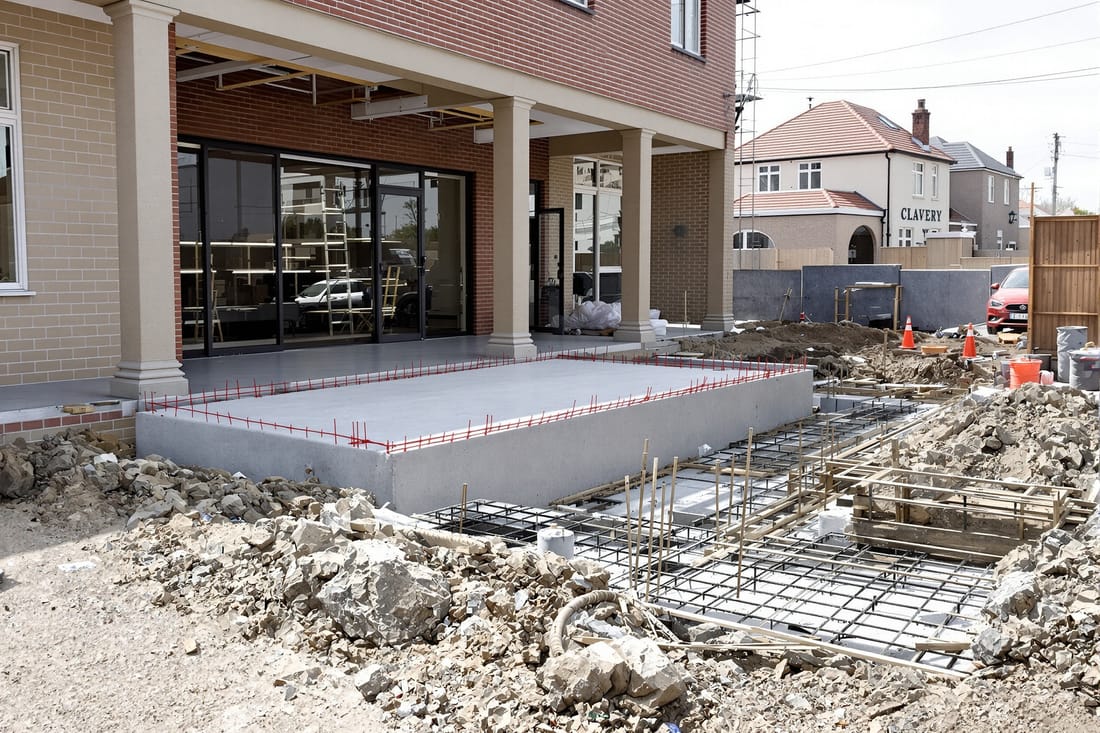
Once the site is prepped, we set forms and reinforcement for the structural concrete. Footings are dug to the required width and depth, which in Chesapeake often means going below the frost line plus any extra depth specified by the engineer for soft soil conditions. For older homes getting an addition, we pay attention to the existing foundation height and type so new concrete lines up correctly and does not create stress points where old and new meet.
Reinforcement depends on the load and the soil. For most structural slabs and footings we use rebar cages, continuous bars, and tied grid patterns. Thicker bars or tighter spacing may be needed for heavy loads such as shops with lifts, warehouse racking, or equipment pads. In some light-duty slabs, we may use welded wire mesh plus strategic rebar at transitions and openings. We anchor dowels into existing concrete when we are tying new structural work into old.
Concrete mix design matters in this climate. We usually specify at least 3000 to 4000 psi mixes for structural work, adjusted for the season. In hot Chesapeake summers, we often pour early in the morning, use mixes with hydration control, and may add set retarders so we have working time. In colder weather, we can use accelerators and insulating blankets so the concrete reaches strength without freezing. Where sulfate exposure or deicing salts are an issue, such as loading docks and some parking areas, we can adjust the mix or add air entrainment and supplementary cementitious materials to improve durability.
Finish type is not just about looks. For structural slabs that will get tile or epoxy, we keep the surface level and within flatness tolerances, and we avoid heavy broom finishes that would interfere with adhesion. For exterior structural slabs such as porch slabs or loading areas, we typically use a light broom for slip resistance and plan control joint spacing to limit random cracking.
Common Problems in Chesapeake and How Superior Concrete Chesapeake Addresses Them
Many concrete problems in Chesapeake come from water and soil conditions, not the concrete itself. Poor drainage around foundations leads to settlement, cracking, and wet crawl spaces. During our sitework, we look for existing drainage issues, such as downspouts dumping next to footings, yards that slope toward the house, or low spots where water stands. We can incorporate swales, regrading, and drain lines into the sitework so your new structural concrete is not sitting in water.
Another frequent issue is inadequate base under slabs. We see garage and driveway slabs that were poured straight on unstable fill or topsoil. Over time, the slab settles and breaks. Our approach is to excavate to stable material, then rebuild the base in layers with proper compaction. For structural slabs over questionable soils, we might recommend thicker sections, extra reinforcement, or even grade beams that spread loads to stronger ground.
Tie-ins to existing structures are another trouble spot. When new structural concrete is not properly connected or separated from older work, you can get differential movement and large cracks where the two meet. Superior Concrete Chesapeake evaluates the condition and level of the existing concrete, then either dowels and key the new concrete into it for a structural tie, or intentionally separate them with expansion joints and proper sealing where movement is expected.
Finally, Chesapeake’s temperature swings and humidity can cause surface scaling and random cracking if joints and curing are handled poorly. We set control joints at appropriate spacing and depth, considering slab thickness, layout, and load paths. We also cure the concrete correctly, by using curing compounds or wet curing methods, so the surface gains strength and resists dusting and early wear.
What Affects Cost and What You Should Know Before Hiring
Sitework and structural concrete pricing in Chesapeake depends heavily on site conditions and design requirements. A flat, open lot with good access and firm soil will cost less than a tight backyard in an older neighborhood with trees, fences, and buried debris. The amount of excavation, off-site disposal of unsuitable material, and imported stone base are major cost drivers. If we need to undercut soft soil or deal with groundwater, we will discuss those options and costs with you before moving forward.
Concrete thickness, reinforcement type, and strength all affect the price. A light-duty patio slab is not the same as a structural slab under a two-story addition. When an engineer specifies larger bars, tighter spacing, or higher psi concrete, it adds material and labor, but it is critical for safety and long-term performance. Superior Concrete Chesapeake reviews the plans with you so you understand where your money is going, and we do not quietly swap specified materials for cheaper substitutes.
Access and scheduling also play a role. If a pump truck is required to reach the pour area, that is an added cost. If the job must be broken into several smaller pours because of access or phasing around existing operations, that affects labor time. On occupied commercial sites, we often schedule early or off-hours to keep your business running, and we plan pour sequences to minimize downtime.
Before you hire any contractor for sitework and structural concrete, ask to see examples of similar projects in Chesapeake, and ask how they handle compaction, drainage, joints, and curing. Make sure they can read and follow structural drawings and will coordinate with your engineer or building inspector. At Superior Concrete Chesapeake, we welcome those questions, provide clear written scopes, and keep you informed from excavation through final finish so you know what is in the ground supporting your building.